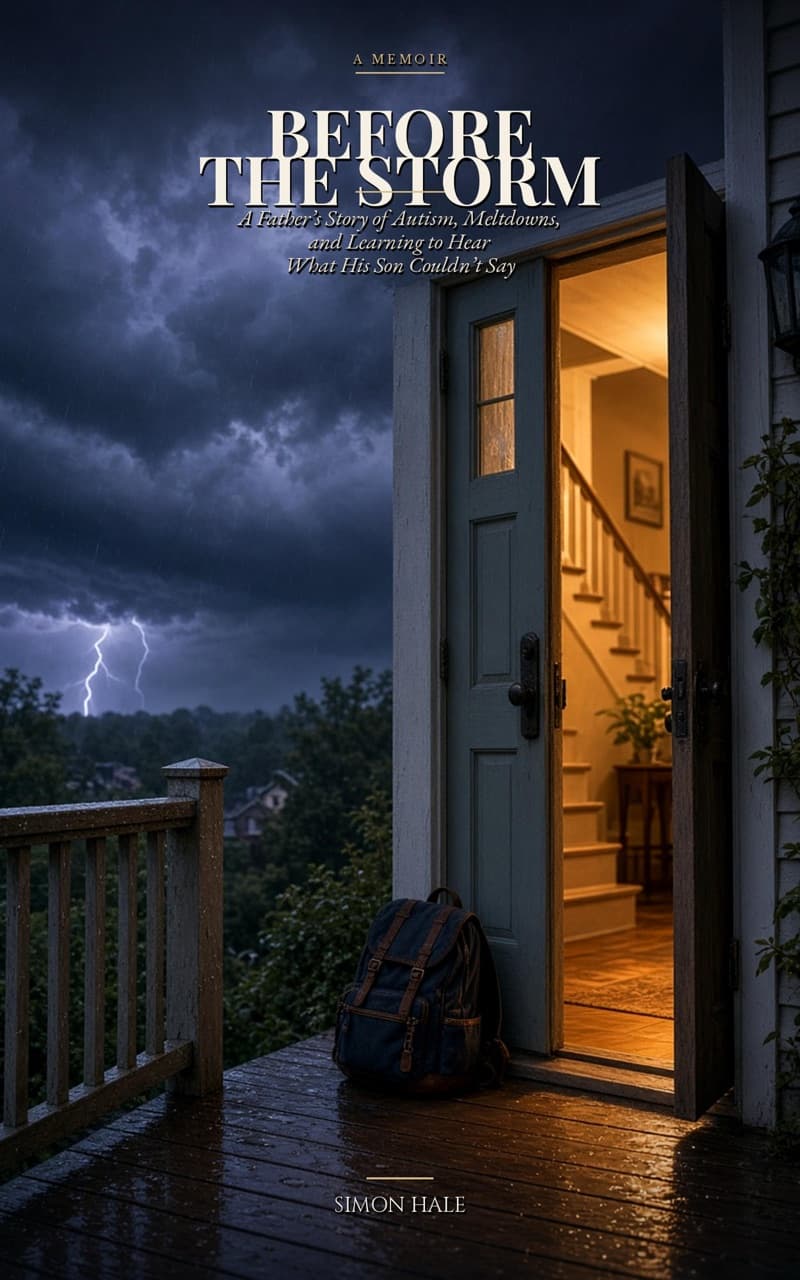
The book
In one line
A father of five spent twelve years learning to hear what his autistic son couldn’t say — and wrote the book he couldn’t find when his family needed it.
In fifty words
Every afternoon the teachers said the same five words: “He had a great day.” And every afternoon, his parents braced at their own front door. Before the Storm is the honest, often funny account of the part of this life that happens where nobody can see it.
In a hundred words
Before the Storm is a father’s account of raising his autistic son — the hour-long storms, the broken windows, the apology his son offers in the middle of a meltdown, and the slow work of learning to read a boy whose body speaks a language his own mind can’t always translate.
It’s unsentimental and frequently funny. It refuses the two stories usually told about this life — tragedy or inspiration — in favor of what actually happens behind the front door at 3:30 in the afternoon. It ends somewhere hopeful without lying to get there.
The meltdown wasn’t the failure. It was the receipt.
The author
Simon Hale is the father of five sons. The youngest is autistic.
He spent his career in business and twelve years learning to read his son — first with his bare eyes, then, after one night at a kitchen table, by building something that could listen to what the boy’s body had been saying all along. He is not a doctor, a therapist or a researcher. He is a father who paid attention, and the book says so on its first page.
On the pen name — please ask about this
Simon Hale is a pen name, and the boy in the book is called Eli rather than his real name. The reason is in the book’s opening pages: “His story deserves telling and his privacy deserves keeping, and I have tried to honor both. Where those two things came into conflict, privacy won.”
It’s not a marketing device and he’s happy to discuss it on air — in a genre where children’s hardest moments are routinely posted for engagement, the decision is part of the story. Audio interviews welcome; video and photographs are declined for the same reason.
Segment ideas
- “He had a great day.”
Why a child who holds it together for seven hours falls apart the moment he’s through the front door — and why that’s evidence of safety, not of bad parenting. The phenomenon has a name most parents have never heard. - The apology in the middle of the meltdown
His son says “Sorry, Mommy” during the storm, not after. For years his father heard that as evidence against him. He had it exactly backwards, and understanding why changed everything. - The 80% divorce statistic is a myth
The number passed around every waiting room and support group has no credible source. A study of roughly 78,000 families found 64% versus 65% — essentially no difference. What the real strain looks like is quieter and more interesting. - I was the problem in that room
He fought the school district for a mainstream classroom and offered to fund the aide himself. His wife told him, at home and quietly, that the classroom he was fighting for was his, not his son’s. She was right. - The boy who reads the room better than anyone in it
The world calls his son’s condition a deficit in reading emotion. He detects tension between his parents from two rooms away, before they’ve admitted it to themselves — and it floods him. - We bought the wrong therapy dog
Fourteen tabs open at midnight, a six-pound companion breed, and a boy for whom love is pressure. The lighter chapter, and a genuinely useful one for families choosing a dog.
Questions a host can ask cold
- Your son’s teachers tell you he had a great day. Why does that sentence make you brace?
- You write that the meltdown wasn’t the failure — it was the receipt. What did you mean?
- People assume a child who’s calm at school and falls apart at home has a problem at home. What’s actually happening?
- Your son apologizes in the middle of a meltdown. You say that frustrated you at first. Can you talk about that?
- Parents like you are told 80% of marriages end in divorce. What’s the truth, and what damage does that number do?
- You fought the school for a mainstream classroom and lost. Why are you glad you lost?
- You describe your son as a barometer for the whole household. What did your family have to change?
- What did the first therapy dog get wrong, and what did the second one get right?
- You write under a pen name to protect your son. How did you decide what was yours to tell and what wasn’t?
- Your son survives a school cafeteria all week, then walks into Monster Jam — the loudest building imaginable — like he’s coming home. What’s the difference?
- What would you say to a parent reading this at midnight, certain they can’t do it another day?
Fast facts
- Title
- Before the Storm: A Father’s Story of Autism, Meltdowns, and Learning to Hear What His Son Couldn’t Say
- Author
- Simon Hale (pen name)
- Publisher
- Staten House
- Publication date
- October 20, 2026
- Formats
- Paperback and Kindle, published the same day
- ISBN (paperback)
- 979-8-90733-836-4
- Category
- Memoir · Autism · Parenting
- Length
- Approx. 21,000 words — a ninety-minute read, written for parents who are exhausted
- Structure
- Fourteen chapters in three acts, with a closing note from the boy’s mother and a plain-language guide to the research behind the story
- Free first chapter
- lovingautism.com
- Buy
- Amazon
- For teachers
- A printable note-home guide for classrooms
Contact
Review copies available on request in ePub or PDF. Available for audio interviews and written Q&A; happy to record remotely at short notice.
Autism is profoundly heterogeneous; this is one family’s experience and is not medical advice.